Mott physics
The model captures the competition between itinerancy and interaction-driven localization.
Strong Correlations • Mott Physics • Lattice Models • Quantum Materials
The Hubbard model is one of the simplest models capable of describing a fundamental competition in condensed matter physics: electrons want to move through a lattice, but they also repel one another. From this simple competition emerges surprisingly rich many-body physics.
Motivation
One of the great successes of solid-state physics is the idea that many electrons in a crystal can often be described approximately as independent quasiparticles moving through an effective periodic potential.
This picture leads naturally to electronic band theory and explains the behavior of many metals, semiconductors, and insulators.
But some materials cannot be understood adequately this way. Electron–electron interactions can become strong enough that they determine the electronic state itself.
The Hubbard model was introduced as a minimal way to study this competition between electron motion and electron repulsion.
Hamiltonian
Despite its compact form, the Hubbard Hamiltonian contains the two ingredients needed to generate a wide range of correlated-electron behavior.
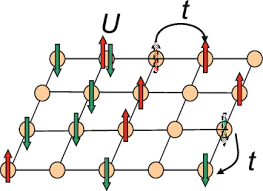
The first term describes an electron moving between neighboring lattice sites.
Larger \(t\) favors delocalization, allowing electrons to spread through the lattice and lowering their kinetic energy.
The second term describes the energetic cost of placing two electrons with opposite spin on the same site.
Larger \(U\) suppresses double occupancy and favors localization.
Competing Energy Scales
Much of the physics of the Hubbard model is controlled by the competition between \(t\) and \(U\), or more generally between the interaction strength and the electronic bandwidth.
Weak Coupling
If the interaction energy \(U\) is small compared with the kinetic energy scale, electrons can move relatively freely through the lattice.
In this regime, the system can often retain a metallic character and may be treated starting from an itinerant-electron picture.
Electron interactions are still present, but they act more as a correction to the motion of otherwise mobile quasiparticles.
Strong Coupling
If \(U\) becomes sufficiently large, putting two electrons on the same lattice site becomes energetically expensive.
An electron may then be prevented from hopping onto a neighboring occupied site even though ordinary band filling would otherwise permit electronic motion.
This interaction-driven localization is at the heart of Mott physics.
Half Filling
A particularly important case occurs when the lattice contains, on average, one electron per site. This is known as half filling for the single-band Hubbard model.
Without strong interactions, electrons could still hop between sites and form an electronic band.
But if the on-site repulsion is sufficiently strong, hopping onto an occupied site creates an energetically costly doubly occupied state. Electron motion can therefore become strongly suppressed.
Mott Insulator
A Mott insulator is one of the most important examples of a state where a simple noninteracting band description becomes inadequate.
The electrons are present at an electronic filling that might permit metallic behavior in a weakly interacting picture, yet strong electron–electron repulsion suppresses charge motion.
This is why the Mott state is fundamentally a many-body phenomenon.
Spin Physics
Even when charge motion is strongly suppressed, the electron spins can still interact.
An electron can virtually hop onto a neighboring occupied site and return. These virtual processes generate an effective magnetic interaction known as superexchange.
In the simplest strong-coupling picture, this interaction favors antiferromagnetic alignment of neighboring spins.
Thus a model that begins only with hopping and on-site repulsion can naturally generate magnetic order.
Physical Picture
If the neighboring site is empty, an electron can hop there with an energy scale determined by \(t\).
If the neighboring site already contains an electron of opposite spin, hopping creates double occupancy and costs an energy \(U\).
When \(U\) is large, electrons avoid double occupancy, suppressing charge motion and creating strong correlations between sites.
Away from Half Filling
The physics becomes even richer when electrons are added to or removed from a half-filled correlated state.
Empty sites or additional carriers provide new possibilities for charge motion while strong local interactions remain important.
The competition among carrier motion, magnetism, and correlations leads to a difficult many-body problem whose complete behavior is still not known analytically in two dimensions.
Connection to Cuprates
The Hubbard model became particularly important after the discovery of high-temperature superconductivity in copper-oxide materials.
The parent cuprates are strongly correlated antiferromagnetic insulators. When carriers are introduced through doping, they evolve into a much richer electronic phase diagram that includes superconductivity.
Because the two-dimensional Hubbard model contains both strong on-site interactions and antiferromagnetic correlations, it became one of the central minimal models used to investigate the underlying physics of the cuprates.
The Challenge
One reason the Hubbard model is so famous is the contrast between how easy it is to write down and how difficult it is to solve.
The many-electron Hilbert space grows extremely rapidly with system size, and interactions prevent the problem from being reduced to independent particles.
As a result, physicists use a wide range of analytical and numerical techniques, including exact diagonalization, quantum Monte Carlo, dynamical mean-field theory, density-matrix renormalization group, cluster methods, and tensor-network approaches.
Connections
The model captures the competition between itinerancy and interaction-driven localization.
Strong-coupling virtual hopping naturally generates antiferromagnetic superexchange.
The Hubbard model provides a minimal theoretical language for discussing doped correlated CuO₂ planes.
Hubbard physics can also be engineered with ultracold atoms in optical lattices, allowing strongly correlated lattice models to be explored in highly controlled experiments.
Why I Find It Interesting
From my condensed matter background
I encountered the Hubbard model through my work on strongly correlated superconducting materials and electron-doped cuprates.
What I find especially interesting is how a Hamiltonian with only hopping and local repulsion can already generate localization, magnetism, and a highly nontrivial doping-dependent phase diagram.
It is a good reminder that in quantum materials, complexity does not necessarily require a complicated microscopic model.
Strongly Correlated Electrons
The Hubbard model captures one of the central themes of condensed matter physics: the behavior of a material cannot always be understood by studying its electrons independently. When interactions become strong, entirely new collective states can emerge.